
RUN "AUTHOR"
Nicolas Korboulewsky.
I have been designing languages, engines and software for more than thirty years. My first computer was a Thomson TO7/70.
TO2026 is a return to the source: the machine where it all began, rebuilt with everything I have learned since.
Explore the machine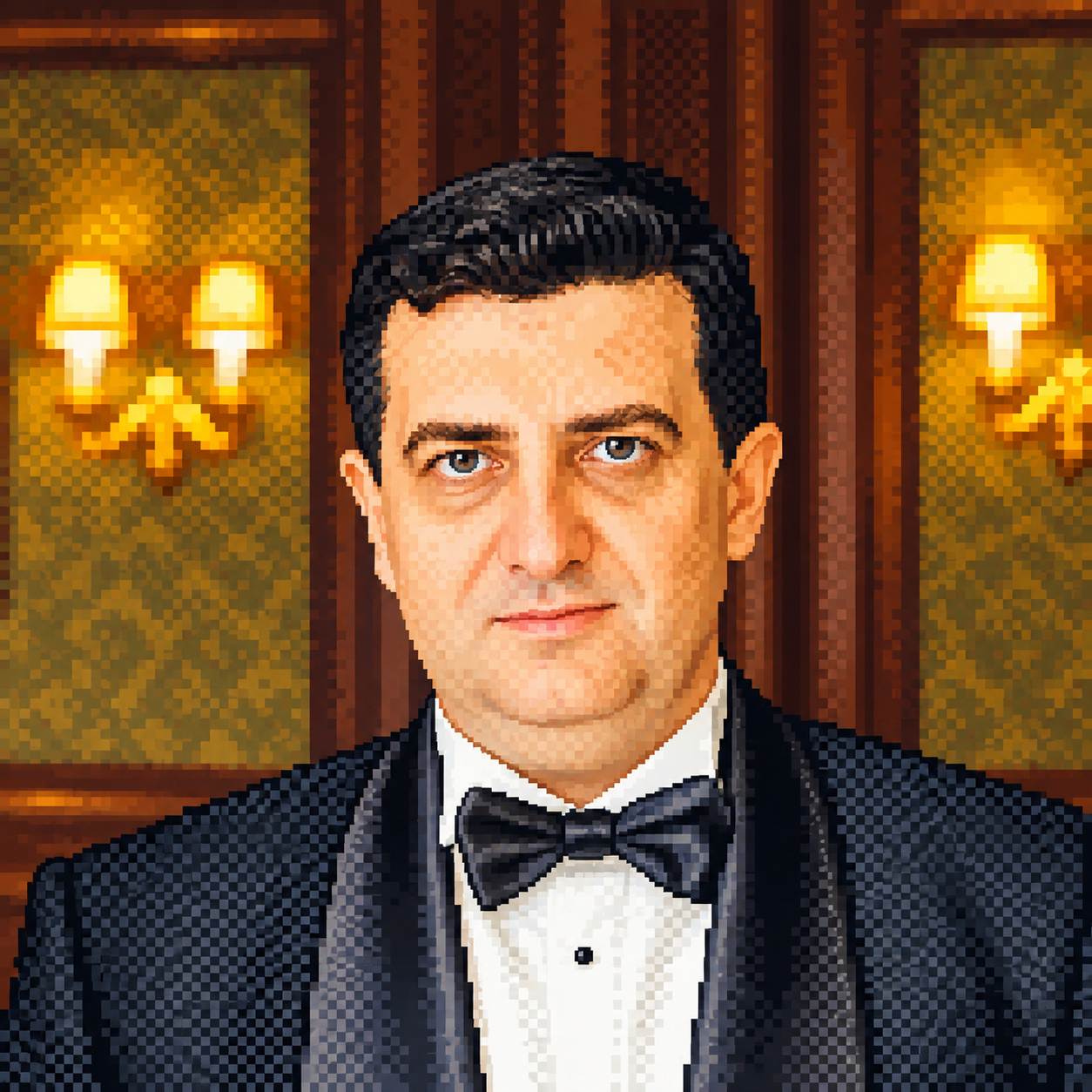
- FIRST COMPUTERThomson TO7/70
- TODAYFounder of ProSuite OOD
- BASED INSofia, Bulgaria
- HIS LANGUAGESBASIC, VVL, and a few others
01 / IN THE BEGINNING
A TO7/70. And the urge to understand how it works.
A screen, a blinking cursor, a light pen: everything was still to be invented.
The TO7/70 was my first computer. TO2026 takes its name, its start-up screen and its colours from it, even though its hardware follows the more complete MO6.
I have never really left that question since: how does a machine understand what we write to it? It led me to neural networks, to languages, to application engines and to artificial intelligence.
Back to the Thomson story02 / LIST
A career, written as a program.
- 1984REMThe TO7/70
Thomson releases the TO7/70. It will be my first computer, and TO2026 is its tribute.
- 1991REMNeural networks
A publication on backpropagation, the method that lets a neural network learn from its mistakes.
- 1999REMVDOM
The VDOM patent. The same technology still drives the new Tekitisy today.
- 2001REMTekitisy
A website editor whose content lives in a database, at a time when pages were still written by hand.
- 2007REMVAILS
Launch of VAILS, an international research project with Tomsk State University and the Bulgarian Academy of Sciences.
- 2026REMTO2026
Tekitisy comes back in a modern version, and this site is built with it. The TO7/70 comes back too, as a virtual machine.
03 / TODAY
ProSuite OOD, in Sofia.
I run ProSuite OOD, a software company developing artificial intelligence and neuro-symbolic technology: the learning of neural networks joined with the rigour of logic. Three building blocks, which I invented, form its core.
VVL
A homoiconic, neuro-symbolic language: a program is itself data it can read and transform. It is grounded in Edward Zalta's theory of abstract objects.
VAILS
The engine that runs VVL on the server, heir to the 2007 research project.
ODESA
The gateway between artificial intelligence agents and business applications.
04 / WHY TO2026
Languages, again and again.
I love languages, especially old and unexpected ones: Simula, Lisp, Prolog, RPL, miniKanren. Each one is another way of thinking about a program.
TO2026 is my playground. I rewrote the MO6's BASIC 128 from scratch, from the 1986 manual, then imagined the BASIC 2026 we would have loved to have back then. The desktop, Plume and Abaque are there to show how far it can go.
It is a personal project, with no commercial aim: a tribute to the Thomson TO/MO family and to everyone who typed their first lines on these machines.
- BASIC
- Simula
- Lisp
- Prolog
- RPL
- miniKanren
- VVL
AUTHOR.BAS
10 CLS
20 PRINT "NICOLAS KORBOULEWSKY"
30 PRINT "FIRST COMPUTER: TO7/70"
40 FOR A=1984 TO 2026
50 LOCATE 0,3:PRINT "YEAR";A
60 NEXT A
70 PRINT "STILL AT THE KEYBOARD"
80 GOTO 70
The machine is waiting for your first program.
Switch it on, choose a BASIC, and type your first line.